


When most people hear the word allergist, they think of sneezing, dust allergies or reactions to certain foods. While these conditions form part of allergy practice, the specialty extends beyond them.
An allergist and clinical immunologist assesses conditions involving an immune system that is overreacting, reacting inappropriately or not working effectively enough. This includes common allergic conditions such as allergic rhinitis and hives, potentially serious reactions such as anaphylaxis and drug allergy, as well as less common disorders affecting immune function.
Because immune-related symptoms can overlap with conditions managed by rheumatologists, dermatologists and other specialists, it is not always obvious which doctor to see. Understanding what an allergist and clinical immunologist treats, and where the specialty differs from rheumatology, can help patients seek the appropriate assessment for their symptoms.
Key Takeaways
- Allergists and clinical immunologists manage allergic conditions as well as selected disorders involving immune deficiency or dysfunction.
- Not every symptom suspected to be an allergy is caused by an allergy, and a positive allergy test does not necessarily mean the allergen is responsible.
- Rheumatologists primarily manage autoimmune and inflammatory diseases, while allergists and clinical immunologists have a different core scope, although some immune-mediated conditions may overlap.
- Specialist training matters. Expertise in rheumatology does not automatically mean expertise in allergy and clinical immunology, or vice versa.
- Allergy and immune testing should be guided by the patient’s symptoms and clinical history rather than broad testing panels alone.
Allergy and Clinical Immunology vs Rheumatology: Which Specialist Should You See?
Allergy and clinical immunology share some overlap with rheumatology, but the specialties have different core areas of focus. Understanding the difference can help patients identify which type of specialist may be appropriate for their symptoms.
What Is Allergy and Clinical Immunology?
Allergy and clinical immunology focuses on conditions in which the immune system responds abnormally or does not function effectively.
This includes allergic reactions, where the immune system responds to normally harmless substances such as house dust mites, pollen, certain foods, medications or insect venom. Clinical immunology also extends beyond allergy to conditions involving immune deficiency or dysregulation.
This broader scope means a clinical immunologist may assess patients with recurrent or unusual infections and other complex immune-related symptoms, even when they do not have a typical allergic condition.
How Is Clinical Immunology Different From Rheumatology?
Rheumatologists primarily diagnose and manage autoimmune and inflammatory conditions such as rheumatoid arthritis, lupus, Sjögren’s syndrome and vasculitis. Their work commonly involves inflammatory joint disease, connective-tissue disorders and systemic autoimmune disease.
Allergists and clinical immunologists have a different core focus, including allergic disease, hypersensitivity reactions, anaphylaxis, immune deficiency and selected disorders of immune function.
There can be overlap when symptoms or immune abnormalities do not fit neatly within one specialty. However, the specialties are not interchangeable. Not every rheumatologist has training in allergy and clinical immunology, just as not every allergist and clinical immunologist is trained to manage complex rheumatic disease.
Some doctors undertake additional training across both disciplines, which may be useful when a patient’s symptoms involve features of allergy, autoimmunity or immune dysfunction.
Which Specialist May Be Appropriate for Your Symptoms?
The appropriate specialist depends on the overall pattern of symptoms and the suspected underlying condition.
Symptoms or Concern | What It May Suggest | Specialist Often Involved |
Sneezing, nasal blockage or itchy eyes | Allergic rhinitis or conjunctivitis | Allergist and clinical immunologist |
Immediate hives or swelling after eating a particular food | IgE-mediated food allergy | Allergist and clinical immunologist |
Recurrent hives without a clear trigger | Chronic spontaneous urticaria | Allergist and clinical immunologist |
Persistent swollen joints with prolonged morning stiffness | Inflammatory arthritis | Rheumatologist |
Dry eyes and dry mouth with joint symptoms | Sjögren’s syndrome or another systemic condition | Rheumatologist, with other specialist input where appropriate |
Frequent, severe or unusual infections | Possible immunodeficiency | Clinical immunologist |
Rash accompanied by joint swelling or other systemic symptoms | Systemic autoimmune or inflammatory disease | Rheumatologist, with dermatology or immunology input where appropriate |
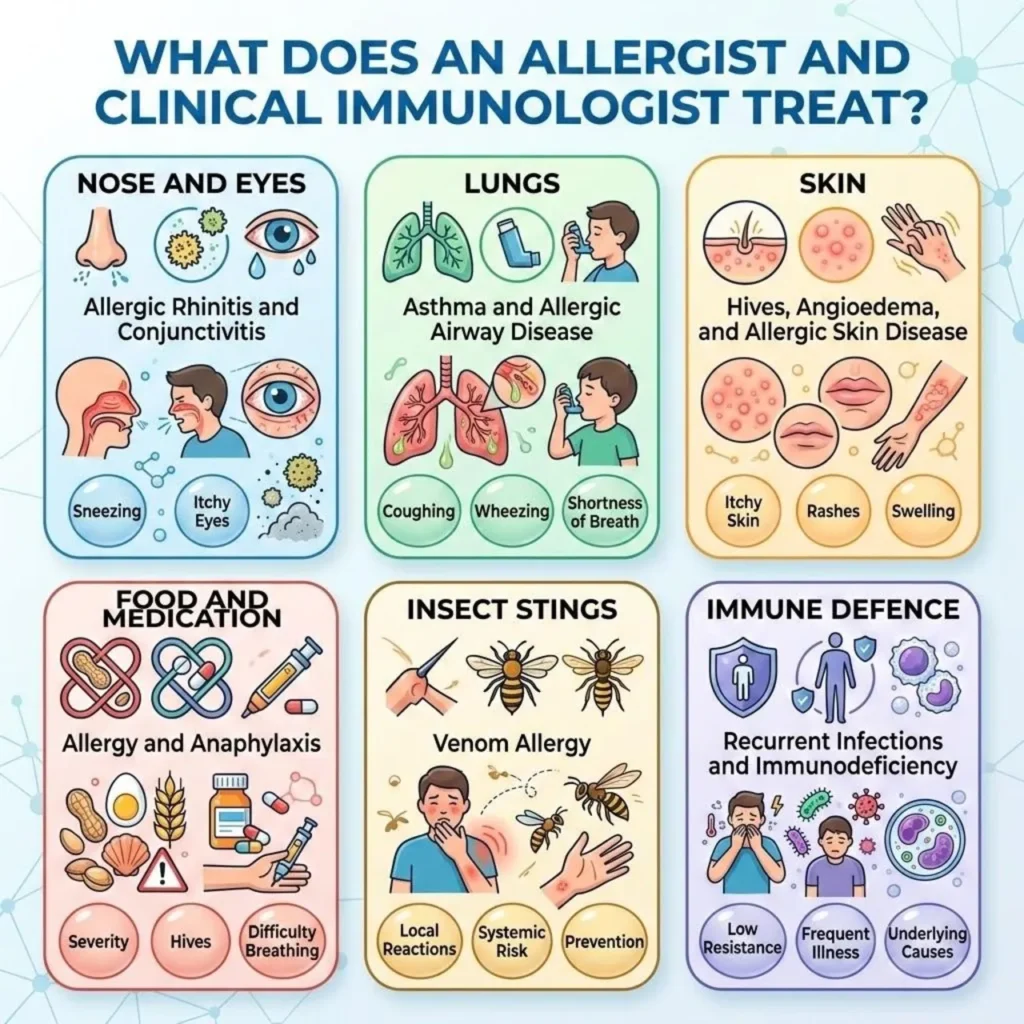
What Conditions Can an Allergist and Clinical Immunologist Treat?
Allergists and clinical immunologists manage conditions ranging from common allergic diseases to disorders affecting how the immune system functions. The exact scope of care may vary according to the specialist’s training and the patient’s clinical needs.
Allergic Rhinitis, Conjunctivitis and Asthma
Allergic rhinitis occurs when exposure to a relevant allergen triggers inflammation inside the nose. Symptoms may include:
- Repeated sneezing or nasal itching
- A blocked or runny nose
- Post-nasal drip
- Itchy, watery or red eyes when allergic conjunctivitis occurs alongside nasal symptoms
In Singapore, house dust mites can be an important trigger because exposure occurs throughout the year rather than during a distinct pollen season. An allergist can assess whether symptoms fit an allergic pattern, identify clinically relevant triggers and advise on appropriate treatment. Allergen immunotherapy may also be considered for selected patients.
Asthma can occur alongside allergic rhinitis or be triggered by allergens such as house dust mites, animal dander, mould or pollen. Allergy evaluation may help identify relevant triggers, but asthma treatment must still address the underlying airway inflammation. For selected patients with allergen-driven asthma, immunotherapy may be considered when the asthma is appropriately controlled.
Food Allergy and Food-Related Reactions
A true IgE-mediated food allergy typically causes reproducible symptoms soon after eating a particular food. These may include:
- Hives or facial and lip swelling
- Vomiting or other acute gastrointestinal symptoms
- Wheezing or throat tightness
- Anaphylaxis in severe reactions
Diagnosis depends on more than a positive allergy test. An allergist will consider what was eaten, how quickly symptoms developed and whether the overall pattern is consistent with an immune-mediated food allergy. Targeted skin-prick or specific-IgE testing may then be used where appropriate.
Food intolerance is different. Symptoms such as bloating, gas, diarrhoea or abdominal discomfort may occur for reasons that do not involve an IgE-mediated allergic reaction. Standard allergy testing therefore cannot reliably diagnose most food intolerances.
Commercial food IgG panels are also not validated for diagnosing food allergy or intolerance. The presence of food-specific IgG commonly reflects exposure to that food rather than proving that it is causing symptoms.
Drug Allergy and Medication Reactions
Not every reaction that occurs while taking medication is a drug allergy. Depending on the symptoms and circumstances, a reaction may instead represent:
- A predictable medication side effect
- Medication intolerance
- An immediate allergic reaction
- A delayed immune-mediated reaction
Distinguishing between these possibilities is important because an inaccurate drug-allergy label can unnecessarily restrict future treatment options.
Assessment begins by establishing what medication was taken, when symptoms developed and what the reaction involved. Depending on the suspected mechanism, further evaluation may include:
- Skin testing for selected medications
- Blood testing in limited situations
- A supervised drug challenge
Desensitisation when an essential medication is required and no suitable alternative exists
Hives, Angioedema and Unexplained Swelling
Urticaria, or hives, causes itchy, raised welts that appear and fade. Acute episodes can sometimes occur with infections or allergic reactions to foods, medications or insect stings.
However, hives that recur for more than six weeks are considered chronic. Chronic spontaneous urticaria is usually not caused by a hidden food or environmental allergy and may instead involve spontaneous mast-cell activation or autoimmune mechanisms. This distinction can help avoid unnecessary allergy testing or food restrictions.
Angioedema causes deeper swelling, commonly affecting areas such as the lips, eyelids, face, hands or feet. It may occur alongside hives or on its own.
When recurrent swelling occurs without hives, further assessment may be needed to consider causes such as:
- Medication-related angioedema
- Hereditary angioedema
- Acquired disorders affecting the complement system
- Other forms of non-histamine-mediated swelling
Swelling of the tongue or throat, particularly when accompanied by breathing difficulty, requires urgent medical attention.
Anaphylaxis and Insect-Venom Allergy
Anaphylaxis is a severe systemic allergic reaction that can develop rapidly and may be life-threatening. Possible triggers include foods, medications, insect venom and latex, although the trigger is not always immediately apparent.
After anaphylaxis, specialist assessment may help determine the likely trigger and whether targeted testing is appropriate. Depending on the circumstances, management may also involve an emergency action plan and guidance on using an adrenaline auto-injector where prescribed.
Insect stings can also cause systemic allergic reactions. Features that may suggest a significant venom allergy include:
- Widespread hives or swelling away from the sting site
- Breathing difficulty
- Dizziness or collapse
For appropriately selected patients with a confirmed venom allergy, venom immunotherapy may substantially reduce the risk of another severe systemic reaction. Large local reactions around the sting site are assessed differently and do not automatically mean that venom immunotherapy is required.
Eczema and Allergic Skin Disease
Atopic dermatitis, commonly called eczema, is an inflammatory skin condition with several contributing factors. It should not automatically be assumed to result from a food or environmental allergy.
Allergy assessment may be useful when there is a convincing history of immediate allergic reactions or when eczema occurs alongside other allergic conditions such as asthma or allergic rhinitis.
Dermatologists remain central to the diagnosis and treatment of eczema and many other skin conditions. Depending on the clinical picture, allergy and dermatology care may overlap.
Recurrent Infections and Immunodeficiency
Clinical immunologists also assess patients when there is concern that the immune system may not be defending against infection effectively.
Possible signs that warrant further investigation include:
- Infections that are unusually frequent or severe
- Repeated pneumonia or infections with unusual organisms
- Recurrent sinus or ear infections that lead to complications
- Infections that respond poorly to standard treatment
- Persistently low immunoglobulin levels
- A family history of immunodeficiency
Frequent infections do not automatically indicate an immunodeficiency. Factors such as allergic or respiratory conditions, smoking and structural airway problems can also contribute to recurrent infections.
Where the clinical pattern raises concern, further investigation may include immunoglobulin levels, assessment of vaccine responses or other targeted immune-system tests.
Immune Dysregulation and Complex Immune Disorders
Some immune disorders do not fit neatly into either allergy or immunodeficiency. Patients may instead develop an unusual combination of recurrent infections, inflammation, autoimmune features or other unexplained symptoms.
Depending on the presentation, these may include:
- Recurrent or unusual infections
- Unexplained fevers or persistent inflammation
- Abnormal blood-cell counts
- Recurrent swelling or rashes
- Gastrointestinal inflammation or other unexplained systemic symptoms
These patterns may require assessment across more than one specialty. Clinical immunologists may work alongside rheumatologists, haematologists, infectious-disease physicians or other specialists to determine whether an underlying immune-dysregulation disorder is contributing to the symptoms.
When Should You Consider Seeing an Allergist and Clinical Immunologist?
Specialist evaluation may be worth considering when allergic or immune-related symptoms are persistent, recurrent or difficult to explain despite appropriate initial care.
Examples include:
- Allergic symptoms that remain troublesome despite appropriate treatment
- Suspected food or medication allergy where the trigger or diagnosis remains unclear
- Recurrent hives, angioedema or unexplained swelling
- A previous episode of anaphylaxis or a serious reaction to an insect sting
- Recurrent, severe or unusual infections that raise concern about immune function
- Previous allergy test results that do not seem to match your symptoms
- A need to assess suitability for allergen immunotherapy or clarify an existing drug-allergy label
The purpose of specialist assessment is not to perform as many tests as possible, but to determine which investigations, if any, are relevant to the clinical problem.
How Does an Allergist and Clinical Immunologist Evaluate Symptoms?
Evaluation begins with the clinical pattern rather than a predetermined panel of tests. The aim is to understand what is happening, whether an allergic or immune mechanism is likely and which investigations could meaningfully clarify the diagnosis.
Clinical History and Symptom Pattern
A detailed history helps the specialist understand how symptoms develop and whether there is a consistent pattern. Depending on the concern, this may involve looking at:
- When symptoms began and how often they occur
- Possible exposures or triggers
- How quickly symptoms develop after an exposure
- Whether the same reaction occurs consistently
- Previous treatments and how symptoms responded
- Relevant allergy, infection or immune history
The type of information that matters will differ according to the problem. For a suspected food allergy, for example, the timing and reproducibility of a reaction can be particularly important. For recurrent infections, the severity, type of infection and occurrence of complications may be more informative than frequency alone.
Targeted Allergy and Immune Testing
Testing is selected according to the clinical question rather than performed indiscriminately. Depending on the suspected condition, investigations may include:
- Skin-prick testing or specific-IgE blood tests for suspected allergens
- Selected drug-allergy testing or supervised drug challenges
- Immunoglobulin levels and assessment of vaccine responses when immunodeficiency is suspected
- Other targeted immune investigations where clinically indicated
Test results must be interpreted in context. A positive allergy test may indicate sensitisation without proving that the allergen is responsible for the patient’s symptoms.
Likewise, broad allergy panels can identify positive results that have little clinical relevance. Testing is most useful when it is chosen to answer a specific question and the result has the potential to change diagnosis or management.
Common Assumptions About Allergy and Clinical Immunology
Allergic and immune-related symptoms are not always straightforward, and some common assumptions can lead to unnecessary testing, avoidance or confusion about when specialist assessment may be useful.
Many Assume | What Specialists Know |
A positive allergy test confirms an allergy. | A positive result shows sensitisation, but does not necessarily prove that the allergen is causing symptoms. Test results need to be interpreted alongside the patient’s clinical history and actual pattern of reactions. |
Chronic hives are usually caused by a hidden food or environmental allergy. | Chronic spontaneous urticaria is usually not driven by an unidentified allergen. Extensive allergy testing or unnecessary dietary restriction may therefore not identify the cause. |
Frequent infections mean the immune system is weak. | Frequency alone does not establish an immunodeficiency. The severity and type of infections, organisms involved, response to treatment and occurrence of complications help determine whether immune investigation is warranted. |
Allergists only treat allergies. | Clinical immunology extends beyond allergic disease. Depending on their training, specialists may also assess immunodeficiency, recurrent or unusual infections and selected disorders involving abnormal immune function. |
Looking Ahead: More Precise Immune Care
Advances in allergy and clinical immunology are supporting more targeted approaches to diagnosis and treatment. Areas of ongoing development include:
- More precise allergy diagnostics and biomarkers to better identify clinically relevant allergies and patterns of immune dysfunction
- Targeted therapies and immunotherapy selection based on specific immune pathways and individual patient characteristics
- Genetic and molecular testing for selected inherited or complex immune disorders
- Digital tools and artificial intelligence that may help relate symptoms to clinical, laboratory and environmental data
These advances may support more personalised care, but they do not replace a careful clinical history. The goal remains to select the right investigations and treatments for the individual patient.
Specialist Care for Allergic and Immune-Related Symptoms at Aaria Rheumatology
Allergic and immune-related symptoms do not always fit neatly into one category. When symptoms are persistent, reactions are difficult to explain or previous test results have created more questions than answers, specialist assessment can help clarify whether allergy, immune dysfunction or another condition may be involved.
At Aaria Rheumatology, patients can be assessed for allergic and immune-related conditions based on their symptoms, medical history and relevant clinical findings. Where appropriate, targeted investigations may be used to clarify the diagnosis and guide further management.
Dr Anindita Santosa is a rheumatologist, clinical immunologist and allergist. Her training across these areas allows her to assess patients whose symptoms may involve allergy, immune dysfunction or overlap with rheumatological disease, and determine when care from another specialty may also be appropriate.
If you have persistent allergic symptoms, unexplained reactions or concerns about how your immune system is functioning, book a consultation with us and discuss what assessment may be appropriate.
Frequently Asked Questions About Allergic and Immune-Related Symptoms
Should I stop antihistamines before an allergy appointment?
Not necessarily. Some antihistamines can interfere with certain allergy tests, particularly skin-prick testing, but they may not need to be stopped for every consultation or investigation. Check with the clinic before your appointment rather than discontinuing medication on your own.
What should I bring to an allergy or immunology appointment?
Bring any previous allergy or immune test results, relevant medical records and an up-to-date list of medications. If you are being assessed for a reaction, photographs of visible symptoms and details about what happened around the time of the reaction may also be useful.
Can allergies develop for the first time in adulthood?
Yes. Allergic conditions can first appear in adulthood, even when the same food, medication or environmental exposure was previously tolerated. New symptoms should still be assessed in context, as not every reaction that develops later in life is necessarily caused by an allergy.
Related Articles
- How Allergy Immunotherapy Works for Allergic Conditions
- Allergy and Clinical Immunology: Essential Insights for Patients
- Urticaria and Autoimmune Disease: Is There a Connection?
- Food Allergy vs Food Sensitivity: What’s the Difference?
- Drug Allergies in Chronic Illness: What Patients Should Know
External References
- American Academy of Allergy, Asthma & Immunology
- American College of Allergy, Asthma & Immunology
- World Allergy Organization
Disclaimer
This article is intended for general educational purposes only and should not replace personalised medical advice. Allergen immunotherapy must be prescribed following an appropriate allergy assessment and administered according to specialist guidance. Suitability, risks, available products, and treatment protocols vary between patients and healthcare settings.