


For many people with allergic rhinitis, treatment becomes a familiar routine: take an antihistamine, use a nasal spray and avoid known triggers whenever symptoms return.
These treatments can be very effective at controlling allergic symptoms and inflammation. However, unlike allergen immunotherapy, they do not generally aim to modify the immune system’s longer-term response to a specific allergen.
Allergen immunotherapy works differently. It gradually exposes the immune system to carefully controlled amounts of a clinically relevant allergen. Over time, this can reduce sensitivity and help the immune system respond less strongly when that allergen is encountered in everyday life.
This process is sometimes described as “retraining” the immune system. It is not a quick fix or suitable for every allergic condition, but appropriately selected patients may experience lasting symptom improvement and reduced reliance on allergy medication.
If allergic symptoms continue to interfere with daily life despite appropriate treatment, understanding how immunotherapy works can help you discuss with an allergy specialist whether it may be a suitable option.
Key Takeaways
- Allergen immunotherapy targets the underlying allergic immune response rather than only relieving symptoms.
- It is most established for allergic rhinitis, allergic conjunctivitis, selected cases of allergic asthma and insect-venom allergy.
- Treatment may be given by injection under the skin or, for selected allergens and products, under the tongue.
- Immunotherapy must be matched to allergens that are both confirmed and clinically relevant.
- A typical treatment course often lasts several years because immune tolerance develops gradually.
How Does Allergy Immunotherapy Work?
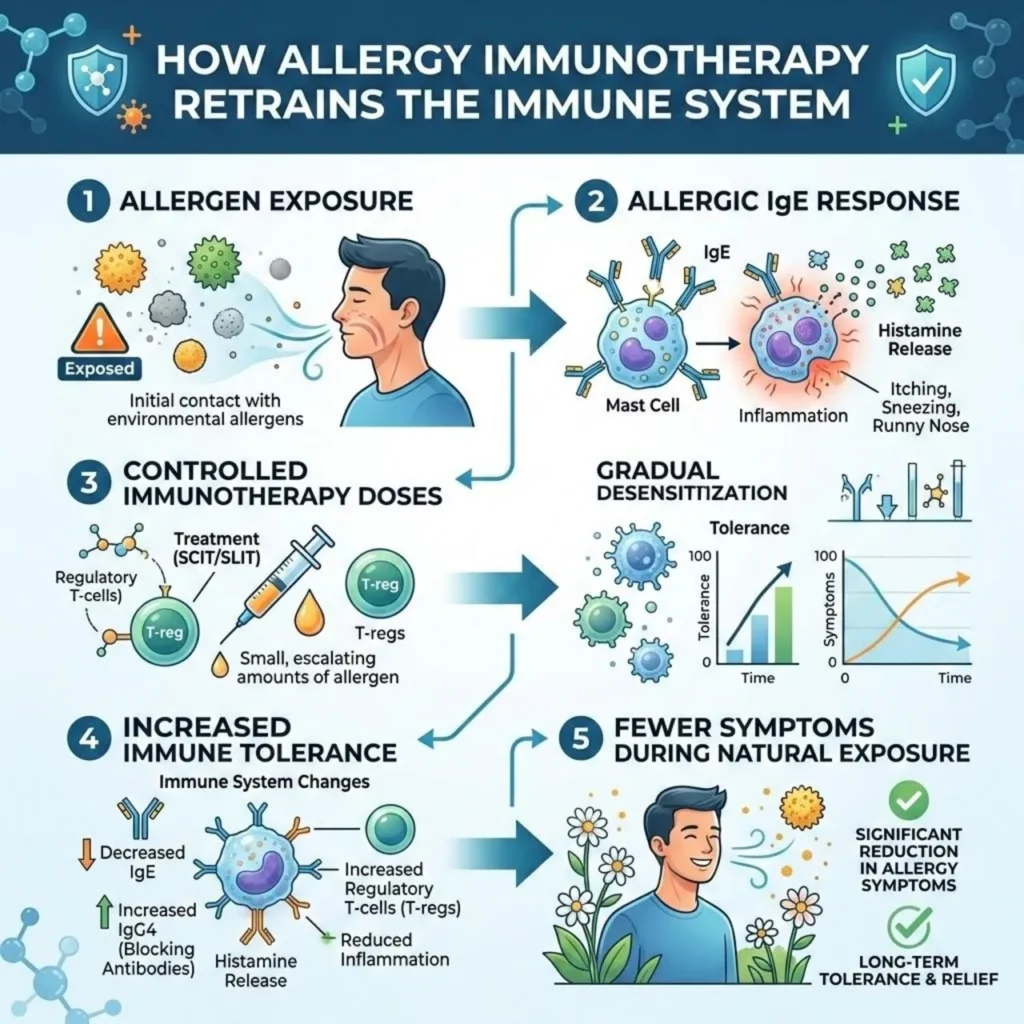
Allergen immunotherapy, sometimes called desensitisation, is a long-term treatment for selected IgE-mediated allergic conditions. It uses carefully controlled amounts of an allergen that has been identified as relevant to a patient’s symptoms.
In an IgE-mediated allergy, the immune system mistakenly identifies a normally harmless substance as a threat. It produces allergen-specific IgE antibodies, which contribute to the activation of immune cells such as mast cells and basophils when the allergen is encountered again. This triggers the release of histamine and other inflammatory substances that cause allergic symptoms.
Immunotherapy repeatedly exposes the immune system to controlled amounts of the relevant allergen. Over time, this can:
- Reduce allergic reactivity
- Promote greater immune tolerance
- Change allergen-specific antibody responses
- Make mast cells and basophils less easily activated
These changes develop gradually. Rather than simply suppressing symptoms when they occur, immunotherapy aims to modify the underlying allergic response so that the immune system becomes less reactive to future exposure.
What to Expect During Allergy Immunotherapy
Allergy immunotherapy is given according to a structured treatment plan. The route, dosing schedule and duration depend on the allergen being treated, the available product and the individual patient.
Types of Allergy Immunotherapy
Two main forms of allergen immunotherapy are subcutaneous immunotherapy (SCIT) and sublingual immunotherapy (SLIT).
Subcutaneous Immunotherapy (SCIT) | Sublingual Immunotherapy (SLIT) | |
How it is given | Allergen extract is injected under the skin | Allergen is placed under the tongue, usually as a tablet or liquid depending on the product |
Treatment schedule | The dose is gradually increased during a build-up phase, followed by maintenance injections at longer intervals | The first dose is generally given under medical supervision, with subsequent doses potentially taken at home if appropriate |
Common reactions | Redness, swelling or itching at the injection site | Mouth itching, throat irritation or mild local swelling |
Where treatment is given | In an appropriate medical setting with observation afterwards | Subsequent doses may be taken at home where appropriate |
SCIT and SLIT are not interchangeable in every situation. The appropriate option depends on the allergen, available standardised products and individual medical circumstances.
How Long Does Treatment Take?
Improvement develops gradually, and some patients may begin to notice a difference within the first year. A complete course commonly lasts around three to five years, although this varies according to the allergen, treatment route and individual response.
Completing the recommended course may improve the likelihood of maintaining benefit after treatment ends.
Can You Still Take Allergy Medication During Immunotherapy?
Yes. Immunotherapy and standard allergy medication are not mutually exclusive. Antihistamines, nasal sprays or prescribed asthma medication may still be used during treatment, particularly in the earlier stages.
Any changes to existing medication should be discussed with the treating doctor.
Is Allergy Immunotherapy Safe?
Allergen immunotherapy is generally safe when appropriately prescribed and administered. Local reactions can occur, including injection-site redness or swelling with SCIT and mouth or throat irritation with SLIT. More generalised allergic reactions are also possible, particularly with injections.
Patients should tell their clinician about:
- Asthma symptoms
- New medications
- Illness on the day of treatment
- Previous reactions
- Pregnancy or planned pregnancy
- Cardiovascular conditions
- Beta-blocker use
Careful patient selection, appropriate dosing and monitoring for reactions are important for treatment safety.
Who May Benefit From Allergy Immunotherapy?
Allergy immunotherapy may be considered when symptoms are linked to a clearly identified allergen and remain troublesome despite appropriate medication or avoidance measures. It may also be worth discussing when exposure is difficult to avoid, medication causes troublesome side effects or the ongoing treatment burden is affecting quality of life.
Allergic Rhinitis and Allergic Conjunctivitis
Allergen immunotherapy is well established for allergic rhinitis and allergic conjunctivitis. It may be considered for patients with clinically relevant allergies, such as house dust mite or pollen allergy, when symptoms remain troublesome despite appropriate treatment.
Allergic Asthma
Immunotherapy may be considered for selected patients whose asthma is clearly linked to a specific allergen.
Asthma should be appropriately assessed and controlled before immunotherapy begins. It is not a substitute for standard asthma treatment and is generally not started when asthma is poorly controlled because of the increased risk of serious allergic reactions.
Insect-Venom Allergy
Venom immunotherapy may be recommended for people who have experienced a significant systemic allergic reaction to an insect sting and have confirmed sensitisation to the relevant venom.
This is a specialised form of allergen immunotherapy and requires appropriate allergy assessment.
When Might Allergy Immunotherapy Not Be Suitable?
Immunotherapy may not be appropriate when the suspected allergen has not been clearly identified, allergy test results do not match the person’s symptoms or the expected benefit is limited.
It is also generally not used to treat:
- Symptoms caused primarily by irritants such as smoke, perfume or air pollution
- Chronic spontaneous urticaria, which is usually not driven by an external allergen
- Food allergies that would be treated with conventional allergy shots or aeroallergen sublingual immunotherapy
Food-allergy immunotherapy is a separate field with different treatment protocols, risks and evidence.
Other factors, including poorly controlled asthma, certain medical conditions or medications, and the ability to follow the required treatment schedule, may also affect whether immunotherapy is appropriate.
Why Does the Allergen Need to Match Your Symptoms?
A positive allergy test shows that the immune system has become sensitised to a particular substance, but it does not necessarily mean that the substance is causing your symptoms. Before immunotherapy is considered, the test result should match when and where symptoms actually occur.
The pattern may become clearer by looking at factors such as:
- Year-round symptoms in Singapore: Allergens such as house dust mites can cause symptoms throughout the year rather than during a distinct allergy season. Regular morning sneezing or nasal blockage, for example, may point towards an ongoing indoor exposure.
- Symptoms around irritants: Haze, cigarette smoke, perfume and air pollution can aggravate nasal, eye or respiratory symptoms, but they are irritants rather than allergens. Immunotherapy cannot desensitise someone to these triggers.
- Symptoms when travelling: Repeated symptoms during pollen seasons overseas that improve after returning home may suggest that a particular pollen exposure is relevant. Seasonal immunotherapy planning may need to begin well before the expected pollen season, depending on the product and protocol.
Matching allergy test results with real-life symptoms helps determine which allergens, if any, are appropriate targets for immunotherapy.
Common Assumptions About Allergy Immunotherapy
Many Assume | What Specialists Know |
Immunotherapy is simply a stronger form of allergy medication. | Unlike antihistamines and other symptom-relieving treatments, immunotherapy aims to modify the immune system’s response to a specific allergen over time. |
Any positive allergy test means immunotherapy will help. | A positive test indicates sensitisation, but the allergen must also match the patient’s symptoms and real-life exposure before immunotherapy is considered. |
Immunotherapy can treat any type of allergy. | Immunotherapy is established for selected IgE-mediated allergic conditions. Conventional allergen immunotherapy is not a general treatment for food reactions, chronic spontaneous urticaria or symptoms caused by irritants. |
Treatment can stop once symptoms improve. | Improvement may occur before the recommended course is complete. Treatment commonly continues for several years to support the development of more sustained immune tolerance. |
How Do Allergy Specialists Assess Whether Immunotherapy Is Suitable?
Before recommending immunotherapy, an allergy specialist will assess whether the symptoms are genuinely allergen-driven and whether treatment can be targeted appropriately.
Assessment may include:
- A detailed allergy history: This looks at when symptoms occur, whether they are year-round or seasonal, and how they change between home, work or travel. Relevant exposures and previous responses to allergy treatment may also be considered.
- Targeted allergy testing: Skin-prick tests or blood tests for allergen-specific IgE can help identify possible triggers. Results are interpreted alongside the patient’s symptoms rather than used in isolation.
- Assessment of related conditions: For patients with asthma or respiratory symptoms, further evaluation such as lung function testing may be needed before immunotherapy is considered.
The specialist will also consider whether the patient can follow the treatment schedule and whether any medical conditions or medications could affect the safety or suitability of immunotherapy.
Broad allergy panels are not always helpful. They may identify sensitisation to substances that are not actually responsible for a patient’s symptoms, which is why testing is usually guided by the clinical history.
Looking Ahead: More Precise Allergy Treatment
Research into allergy immunotherapy continues to explore ways to identify which patients are most likely to benefit and make treatment more targeted.
Areas being studied include:
- Biomarkers: Identifying biological markers that may help predict how well a patient is likely to respond to immunotherapy.
- Allergen preparations and dosing: Improving the standardisation of allergen extracts and exploring how dosing may be better tailored to individual patients.
- Shorter treatment schedules: Investigating approaches that could reduce treatment duration or make immunotherapy more convenient.
- Combination approaches: Studying how immunotherapy may be used alongside treatments such as biologic therapies in selected patients.
- Digital symptom tracking: Comparing symptoms with allergen exposure over time to provide a clearer picture of individual allergy patterns.
- Environmental monitoring: Using information such as pollen and air-quality data to better understand when symptoms occur and what may be contributing to them.
Artificial intelligence may also have a future role in bringing together information from symptom tracking, environmental exposure and clinical findings to help identify patterns over time.
Regardless of how these approaches develop, effective immunotherapy still depends on identifying an allergen that is genuinely relevant to the patient’s symptoms.
Personalised Allergy Immunotherapy at Aaria Rheumatology
For patients considering allergy immunotherapy, the key question is not simply whether an allergy test is positive, but whether the identified allergen is genuinely responsible for their symptoms and can be appropriately targeted. A specialist assessment can help establish this before a long-term treatment plan is considered.
At Aaria Rheumatology, allergy symptoms are assessed alongside your medical history and exposure patterns to determine whether they are allergen-driven and whether immunotherapy may be appropriate. Where needed, targeted allergy testing can help identify clinically relevant allergens and guide the choice of treatment.
Dr Anindita Santosa is a rheumatologist, clinical immunologist and allergist who can assess whether allergen immunotherapy may be suitable based on your symptoms, allergy history and test findings.
If allergies continue to shape where you go, how you sleep, or how you function, book a consultation with us and discuss the appropriate next steps.
Frequently Asked Questions About Allergy Immunotherapy
Can allergy immunotherapy cure allergies?
Allergy immunotherapy is generally intended to reduce sensitivity to a specific allergen rather than guarantee a permanent cure. Some patients may continue to experience benefits after completing treatment, but the degree and duration of improvement can vary.
Can allergy immunotherapy prevent new allergies from developing?
Some research has explored whether allergen immunotherapy may influence the longer-term course of allergic disease, including the development of additional sensitisation. However, preventing new allergies is not guaranteed and should not be the primary reason for starting treatment.
What happens if you miss a dose of allergy immunotherapy?
What happens next depends on the type of immunotherapy and how much time has passed since the missed dose. The treatment schedule may need to be adjusted rather than simply resumed at the previous dose. Patients should follow the instructions of their treating specialist rather than changing the schedule themselves.
Related Articles
- Allergy and Clinical Immunology: Essential Insights for Patients
- Urticaria and Autoimmune Disease: Is There a Connection?
- Food Allergy vs Food Sensitivity: What’s the Difference?
- Drug Allergies in Chronic Illness: What Patients Should Know
External References
- European Academy of Allergy and Clinical Immunology: Allergen Immunotherapy Guidelines
- American Academy of Allergy, Asthma & Immunology: Allergy Shots and Sublingual Immunotherapy
- National Environment Agency Singapore: Air Quality and Haze Information
Disclaimer
This article is intended for general educational purposes only and should not replace personalised medical advice. Allergen immunotherapy must be prescribed following an appropriate allergy assessment and administered according to specialist guidance. Suitability, risks, available products, and treatment protocols vary between patients and healthcare settings.