


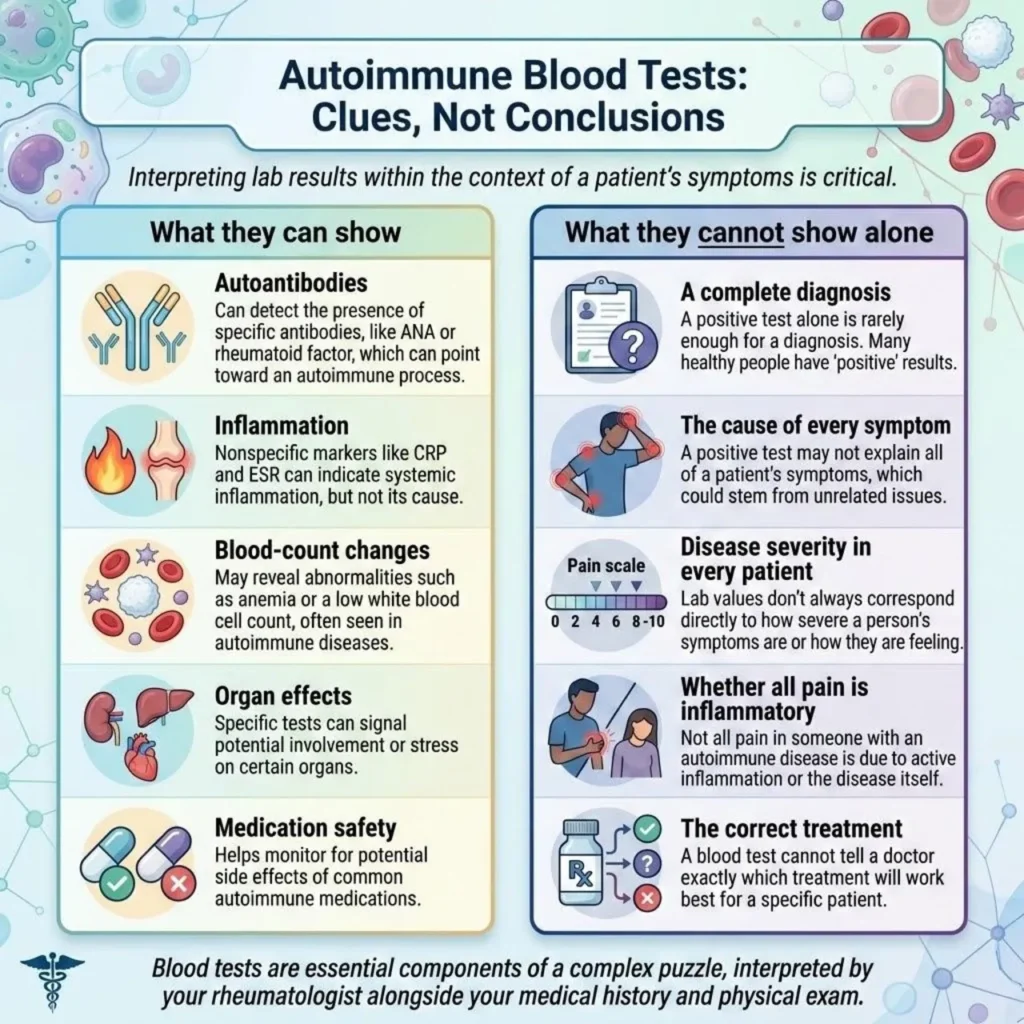
Blood tests are an important part of investigating autoimmune disease, but their results are rarely simple yes-or-no answers. A positive result does not always mean that an autoimmune condition is present, while normal or negative results do not necessarily rule one out.
Different tests provide different types of information. Some detect autoantibodies associated with particular conditions, while others look for inflammation, changes in blood cells or signs that organs may be affected. Blood tests may also be used to monitor disease activity or check that treatment is being used safely.
What a result means depends on why the test was ordered and how well it fits with the patient’s symptoms and examination findings. Even the same abnormal result can carry very different significance in two people with different clinical presentations.
This is why autoimmune disease is rarely diagnosed from bloodwork alone. Results are interpreted as part of a wider clinical picture that may also include physical examination, imaging, urine tests and how symptoms develop over time.
If an abnormal autoimmune blood test has left you concerned, or your results appear normal despite persistent symptoms, understanding what these tests can and cannot show can help you discuss the findings more meaningfully with your doctor.
Key Takeaways
- There is no single blood test that can confirm or rule out every autoimmune disease.
- A positive autoantibody result may support a diagnosis, but does not necessarily mean that autoimmune disease is present.
- Normal inflammatory markers or negative antibody tests do not rule out every autoimmune or inflammatory condition.
- Different blood tests serve different purposes, from detecting autoantibodies and inflammation to assessing organ involvement or monitoring treatment safety.
- Results are most meaningful when interpreted alongside symptoms, examination findings, other investigations and how the condition develops over time.
What Can Autoimmune Blood Tests Detect?
Blood tests can provide different types of information when autoimmune disease is suspected. Some look for antibodies associated with particular conditions, while others help identify inflammation, changes in blood cells or possible organ involvement.
Autoantibodies
Autoantibodies are antibodies directed against components of the body’s own cells or tissues. When they match the patient’s symptoms and examination findings, they can provide useful evidence for a particular autoimmune disease.
Common examples include:
- ANA (antinuclear antibody): May be positive in lupus, Sjögren’s disease, systemic sclerosis and other connective-tissue diseases, but can also occur in healthy people.
- Anti-dsDNA and anti-Smith: More closely associated with lupus than ANA alone. Anti-dsDNA may also be considered alongside other findings when assessing lupus activity.
- ENA antibodies: These include anti-Ro/SSA, anti-La/SSB, anti-Smith, anti-RNP and selected antibodies associated with other connective-tissue diseases.
A positive autoantibody does not establish a diagnosis on its own. Its significance depends on the clinical presentation and, where relevant, factors such as the antibody level or titre.
Rheumatoid Factor and Anti-CCP Antibodies
Rheumatoid factor (RF) and anti-CCP antibodies are commonly tested when rheumatoid arthritis is suspected.
- Rheumatoid factor can support the diagnosis but may also be positive in other autoimmune conditions, chronic infections and some people without rheumatoid arthritis.
- Anti-CCP antibodies are more specific for rheumatoid arthritis and can provide stronger supporting evidence when the clinical features fit the condition.
Some people with rheumatoid arthritis test negative for both. This is known as seronegative rheumatoid arthritis, which is why negative antibody tests do not automatically rule the condition out.
Inflammation
C-reactive protein (CRP) and erythrocyte sedimentation rate (ESR) can indicate systemic inflammation, but neither is specific to autoimmune disease.
Raised levels may occur with inflammatory disease, infection, tissue injury or other illnesses. Conversely, normal ESR or CRP results do not necessarily exclude inflammation, particularly when it is limited or intermittent.
Blood Cells, Organ Function and Treatment Safety
Other blood tests can provide supporting information about how a condition is affecting the body or help doctors monitor treatment.
Depending on the clinical situation, these may include:
- Full blood count: Can identify changes such as anaemia or abnormalities in white blood cells or platelets.
- Kidney and liver function tests: May help identify organ involvement and are also used to monitor the safety of certain medications.
- Creatine kinase: May be measured when muscle inflammation is suspected.
- Complement levels: C3 and C4 may provide useful information in selected conditions such as lupus, although abnormal results are not diagnostic on their own.
- Infection screening: May be required before or during treatment with certain immune-modifying medications.
Blood tests may also need to be combined with other investigations. For example, urine testing can be important when assessing possible kidney involvement in lupus.
Why Blood Test Results Do Not Always Give a Clear Diagnosis
Autoimmune blood tests provide evidence, but their meaning depends on the clinical context. The same result can carry very different significance depending on a person’s symptoms, examination findings and likelihood of having the condition being investigated.
A Positive Result Does Not Always Confirm Disease
Some autoantibodies can be detected in people who do not have the autoimmune disease commonly associated with them. This is why a positive result needs to be considered alongside the reason the test was ordered.
For example:
- A person with prolonged morning stiffness and swollen finger joints who tests positive for anti-CCP has a clinical pattern that strongly supports rheumatoid arthritis.
- A person without joint swelling or inflammatory symptoms who receives the same test as part of a broad screening panel may require a very different interpretation.
Doctors sometimes describe this as pre-test probability: how likely a condition appeared to be before the test was performed. Testing people without a clinical reason to suspect a particular disease increases the chance of finding positive results that may not be clinically relevant.
A Negative Result Does Not Always Rule Disease Out
Not every autoimmune or inflammatory disease produces a characteristic antibody, and some people with antibody-associated conditions can still test negative.
Conditions that may occur despite negative antibody testing include:
- Rheumatoid arthritis
- Psoriatic arthritis
- Axial spondyloarthritis
- Selected cases of Sjögren’s disease
A negative result may make a particular diagnosis less likely, but it does not automatically explain persistent symptoms. Examination findings, imaging and how the condition develops over time may provide additional evidence.
Normal Inflammatory Markers Do Not Always Exclude Inflammation
ESR and CRP reflect systemic inflammation, but they do not detect every form of inflammatory disease. Results may remain normal when inflammation is mild, intermittent or concentrated in particular joints or tissues.
Blood tests also cannot determine on their own whether every painful joint is inflamed, establish the cause of nonspecific symptoms such as fatigue or show the full extent of organ involvement.
The question is therefore not simply whether a result falls inside or outside the laboratory reference range, but whether it makes sense within the patient’s overall clinical picture.
Common Assumptions About Autoimmune Blood Tests
Autoimmune blood-test results can be easy to overinterpret, particularly when a result is viewed without the symptoms and clinical findings that prompted the test.
Many Assume | What Rheumatologists Know |
A positive ANA means I have lupus. | ANA is commonly positive in lupus, but it can also occur in other conditions and in healthy people. A positive result does not diagnose lupus on its own. |
Negative rheumatoid factor means I cannot have rheumatoid arthritis. | Rheumatoid arthritis can occur despite a negative rheumatoid factor and anti-CCP results. These cases are described as seronegative rheumatoid arthritis. |
Normal ESR and CRP mean there is no inflammation. | Inflammatory markers can remain normal when inflammation is limited, intermittent or not strongly reflected in the bloodstream. |
A higher antibody level always means the disease is more severe. | Not every autoantibody level reflects disease activity or symptom severity. The significance depends on the antibody and the condition being assessed. |
Ordering more autoimmune tests makes the diagnosis more accurate. | Broad testing without a clear clinical reason can uncover incidental positive results that are difficult to interpret. Targeted testing is usually more informative. |
How Do Rheumatologists Decide Which Blood Tests Are Useful?
Autoimmune blood tests are most useful when they are selected to investigate a specific clinical concern. Rather than testing broadly for every possible autoimmune condition, a rheumatologist considers the pattern of symptoms and examination findings before deciding which investigations may provide useful information.
Blood tests may be considered when there are features such as:
- Persistent joint swelling or prolonged morning stiffness
- Unusual or photosensitive rashes
- Recurrent mouth ulcers
- Raynaud’s phenomenon accompanied by other systemic symptoms
- Persistent dry eyes and dry mouth with features suggesting systemic disease
- Unexplained abnormalities in blood counts
- Muscle weakness suggestive of an inflammatory muscle condition
- Kidney or urine abnormalities
- Symptoms that raise concern about vasculitis
Testing should answer a clinical question, rather than simply search broadly for an abnormal result.
Once results are available, the rheumatologist considers whether they fit the patient’s symptoms and examination findings. The strength and pattern of abnormal results, possible alternative explanations and previous test findings may all affect their significance.
Blood tests are also only one part of the assessment. Depending on the suspected condition, ultrasound, X-ray or MRI may help identify inflammation or structural changes, while urine testing and other organ-specific investigations may be needed when systemic disease is suspected.
Some autoimmune diseases also become clearer over time. When the initial picture is uncertain, clinical follow-up may sometimes provide more useful information than repeatedly ordering broad panels of blood tests.
Classification Criteria Are Not the Same as Diagnosis
Patients researching autoimmune conditions may come across scoring systems or classification criteria online and use them to assess whether they have a particular disease. While these criteria can be useful, they are not always intended to function as diagnostic checklists.
Classification criteria are often developed to identify sufficiently similar groups of patients for research. Rheumatologists may consider them as part of clinical assessment, but diagnosis still depends on the wider clinical picture.
This means that:
- Not meeting a classification threshold does not necessarily rule out disease. Some autoimmune conditions evolve gradually, and a patient may have clinically meaningful disease before all classification features are present.
- Meeting a classification threshold does not automatically confirm disease. Another condition may explain the symptoms and test findings more convincingly.
Blood-test results and classification scores therefore need to be interpreted alongside the patient’s symptoms, examination findings and other investigations rather than used as standalone diagnostic tools.
Looking Ahead: More Precise Autoimmune Testing
Research into autoimmune disease is increasingly focused on combining different types of information rather than relying on a single antibody or inflammatory marker.
Areas being explored include:
- More precise biomarkers: New combinations of laboratory markers may help distinguish clinically meaningful autoimmune activity from incidental abnormalities.
- Immune and molecular profiling: Advances in immune-cell, genetic and molecular analysis may provide more detailed information about how particular autoimmune diseases behave.
- Better integration of clinical data: Combining laboratory findings with imaging, symptoms and other clinical information may help doctors identify patterns that individual tests cannot show on their own.
- Digital and AI-assisted tools: Emerging technologies may eventually help analyse complex clinical, laboratory and imaging data together to support earlier or more precise assessment.
These approaches may improve how autoimmune diseases are identified and monitored, but the goal is not simply to perform more tests. It is to obtain information that meaningfully improves diagnosis and patient care.
Specialist Review of Autoimmune Blood Tests at Aaria Rheumatology
Autoimmune blood-test results can be difficult to interpret in isolation. A positive result may raise questions about whether an autoimmune condition is present, while normal or negative results can be equally frustrating when symptoms persist.
At Aaria Rheumatology, blood-test findings are assessed alongside your symptoms, medical history and examination findings to determine whether they fit an autoimmune or inflammatory pattern. Where appropriate, further targeted investigations or imaging may be recommended to clarify the diagnosis or monitor how the condition develops over time.
Dr Anindita Santosa is a consultant rheumatologist who assesses and manages autoimmune and inflammatory conditions. She can help interpret abnormal or uncertain test results within the wider clinical picture and determine whether further rheumatological assessment is needed.
If you have abnormal autoimmune blood-test results or ongoing symptoms despite reassuring results, book a consultation with us to discuss what the findings may mean and whether further assessment is appropriate.
Frequently Asked Questions About Autoimmune Blood-Test Results
Can autoimmune blood-test results change over time?
Yes. Some laboratory results may change as a condition develops or its activity changes, while others can remain positive regardless of how active the disease is. Whether a test needs to be repeated depends on the marker, the suspected or confirmed condition and what clinical question the doctor is trying to answer.
Should I stop any medications before an autoimmune blood test?
Usually, you should continue prescribed medication unless your doctor has advised otherwise. Some medicines can affect particular laboratory results or need to be considered when interpreting them, so tell your doctor what prescription medicines, over-the-counter products and supplements you are taking before testing.
Do I need to fast before autoimmune blood tests?
Many autoimmune antibody and inflammatory-marker tests do not require fasting. However, other blood tests ordered at the same time may have different preparation requirements. Follow the instructions provided by your clinic or laboratory for the specific tests being performed.
Related Articles
- Why Autoimmune and Inflammatory Pain May Not Show Up on Scans or Blood Tests
- Early Signs of Rheumatoid Arthritis Patients Often Miss
- Early Sjögren’s Syndrome Symptoms Patients Often Overlook
- What Conditions Does an Allergist and Clinical Immunologist Treat?
- When Joint Pain Could Be More Than “Just Ageing”
External References
- American College of Rheumatology: Antinuclear Antibodies
- American College of Rheumatology: Rheumatoid Arthritis
- European Alliance of Associations for Rheumatology
- Choosing Wisely: Appropriate Autoimmune Testing
Disclaimer
This article is intended for general educational purposes only and should not replace personalised medical advice. Blood-test results must be interpreted in the context of an individual’s symptoms, examination findings, medical history and other investigations. Do not start, stop or change treatment solely on the basis of an online interpretation or isolated laboratory result.